Dentists

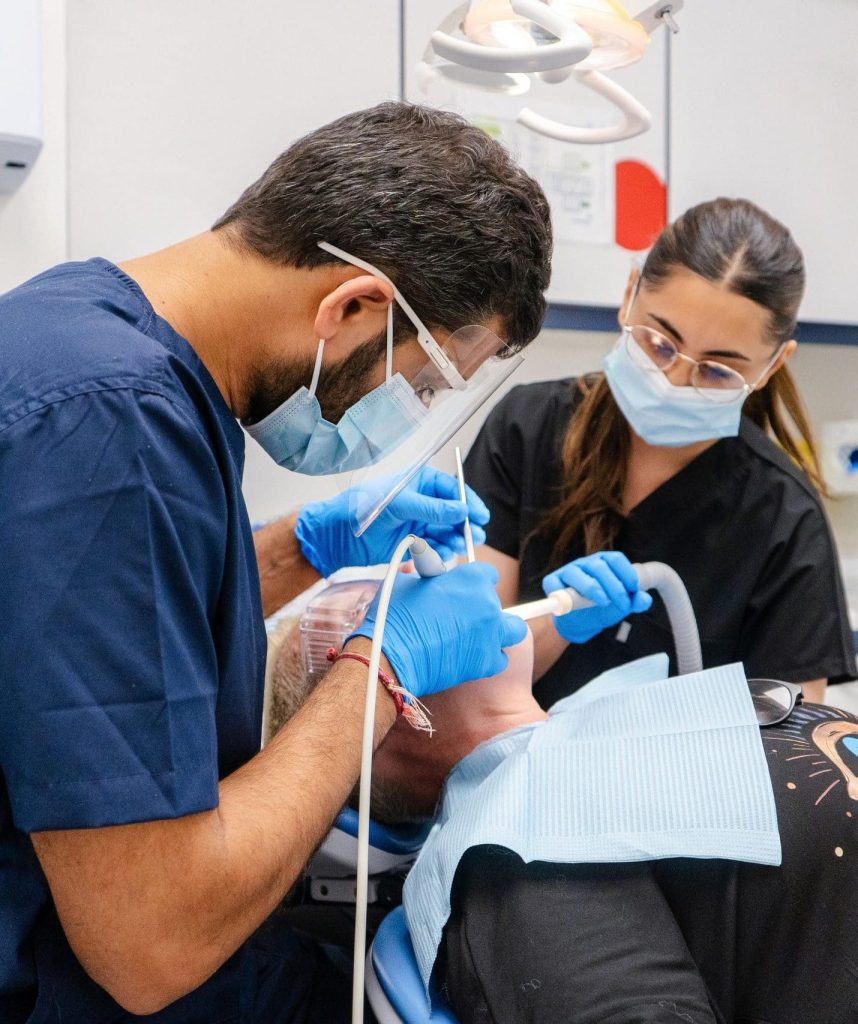
Dentists provide treatment to keep your mouth, teeth and gums healthy and free of pain.

The NHS will provide all treatment that your dentist feels is clinically necessary. While some people are eligible for free treatment, dentistry is one of the few NHS services where you have to contribute to the cost of your care.

Some dentists provide a mixture of NHS and private care. If you are unsure what services your dentist provides, check with your dentist. All dentists have information on the NHS services they have agreed to provide.

Visit the NHS website for more information about dental costs, including eligibility for free treatment.

Your dentist can:

  • provide regular check ups on your teeth and gums (adults should have a check up at least every two years, under 18’s should have a check up at least once a year)
  • teach you how to look after your teeth and gums to prevent problems
  • restore teeth damaged or lost due to decay, in an accident or other reasons

Registering with a dentist

Dental practices are independent businesses, often providing a combination of NHS and private dentistry. Patients are not registered with a dentist in the same way they are with a GP practice.

If you have an NHS dentist, you should contact the surgery by phone or in person. If you don’t have an NHS dentist, you can find one using the NHS website.

Find an NHS dentist near you

We are aware of the extensive waiting lists for children and adults, and we are exploring ways to address this issue. Although some practices are putting on additional capacity for new patients, this does not mean that they will be able to accommodate all new patient requests.


If you need urgent dental care

Urgent dental appointments are available to support you if you are suffering with pain caused by dental issues, including infections or swellings in the mouth, broken or badly moved teeth or bleeding in the mouth that does not stop.

You can request an appointment for urgent dental care in the following ways:

There are also several non-urgent dental problems which may require immediate attention from a dentist, such as loose or broken crowns and fillings, teeth that are wobbly or mild to moderate toothache.

Find out more about urgent, emergency and out of hours dental care and what can be treated on the NHS website.

Feedback and complaints

If you’re not satisfied with the urgent dental treatment you have received, or if you have a question, feedback or complaint about dental services, contact NHS Bristol, North Somerset and South Gloucestershire ICB.

Our strategy to improve dental care

As in other parts of the country, access to NHS dentists in Bristol, North Somerset and South Gloucestershire has been very challenging, with demand for care outweighing available appointments.

Our Oral Health and Dental Strategy 2024 to 2027 has three aims to improve oral health for everyone in our area:

  • Promoting good oral health across our entire local population.
  • Reducing health inequalities by increasing access to NHS dental provision.
  • Developing the workforce, retaining staff and attracting more applicants.
Read our Oral Health and Dental Strategy 2024 to 2027

Supervised toothbrushing scheme

Some primary schools and early years settings in Bristol, North Somerset and South Gloucestershire are taking part in the Big Brush Club, a supervised toothbrushing scheme designed to improve oral health among young children.

Funded by the NHS and delivered by At Home Dental, the Big Brush Club promotes oral health in educational settings and provides teaching staff with training and resources to run supervised toothbrushing sessions in the classroom.

The scheme was introduced to tackle high levels of tooth decay among children, a leading cause of hospital admissions. Through supervised tooth brushing and promoting routines at home, the Big Brush Club aims to prevent dental problems, reduce missed school days, and improve overall wellbeing.

Find out more about the Big Brush Club